
The Story of the Revolution That Created the Panama Canal
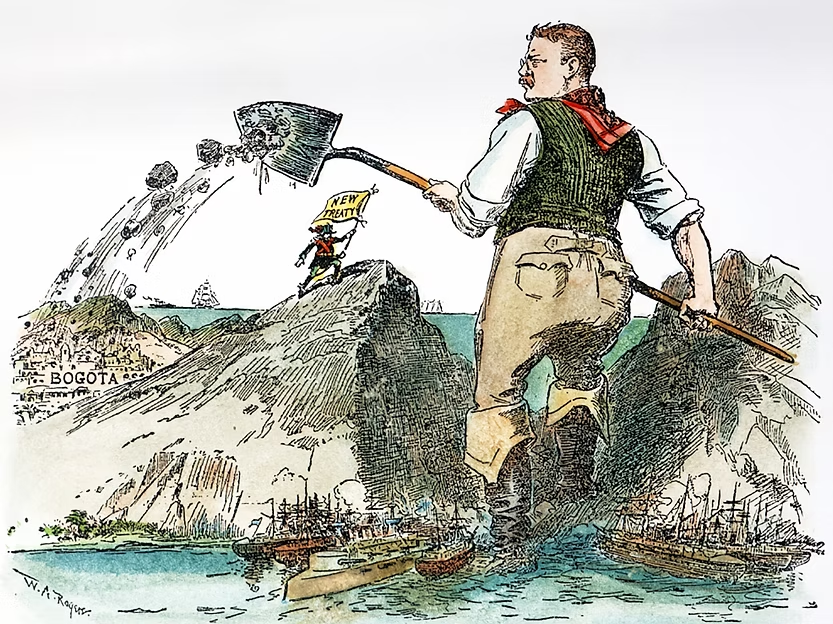
President Theodore Roosevelt was informed by Philipe Bunau-Varilla during their meeting that a revolution in Panama was about to take place. He asked him the question every Panamanian wanted to know: Will the United States prevent Colombian troops from landing when the revolution breaks out? He added “I suppose you can’t say,” to which Roosevelt responded decisively: “I cannot!” Roosevelt wanted to remain as vague as possible about his comments on the revolution. Any direct involvement could lead to war between the US and Colombia, something he certainly wanted to avoid. However, Roosevelt was interested in a Panamanian revolution and what he could get out of it. It was the opportunity to finally get the rights to build his so-desired Panama Canal, a project he’d had his eyes on for years. But the story of the Panama Canal or the Panamanian Revolution of 1903 started much earlier than this meeting. In fact, the story of how the Panama Canal came to be is one of the most interesting stories in American history.
Talks of a Canal
For years, there had already been talks around the world about digging a canal through Central America. Multiple attempts had already been made before the American government even got involved. The most important of which was initiated by a French company, called the New Panama Company, which began a project for building a canal in Panama right after it had dug the highly successful Suez Canal. They had experienced the success that the canal produced and wanted to reproduce this in Panama. This Panamanian project however, hopelessly failed, most people who worked on the project died because of the dire circumstances and progress was slow. Eventually, the entire project was abandoned, but the French still left the infrastructure in place.
In the US there had been talks for a while about building a canal through Central America. They believed a canal to be a crucial addition to the American continent and the world by improving the ability to trade and increasing national security. Before the canal, when ships had to move from the east to the west coast or vice versa, they had to sail all the way around the American continent, around the bottom of South America. This was a risky journey through tough waters and climates and took a long time. This meant that commerce between East and West by ship was barely profitable and slow, and when the US Navy had to move from coast to coast, it could not react quickly to threats. The solution to this issue would be a canal that would cut through Central America. It would severely shorten the distance that American ships would have to cover to move from one side to the other and, as a result, it would stimulate commerce and increase national security by making transport by ship faster and easier.
The first proposal of the US government was to dig this canal through Nicaragua. This location was chosen based on several arguments. First, the Panama project had failed, and not without reason. The terrain in Panama was difficult to get through, it had lots of jungle, diseases were rampant, and therefore the project seemed too difficult. Nicaragua also had several advantages over Panama: it was less jungle-like, the distance to the United States was a lot shorter, and, unlike Panama, Nicaragua was politically stable. Nicaragua was the first option for a canal for a long time, until Roosevelt received an offer from the New Panama Company.
The offer was the following: they would be willing to sell the rights to the Panama Canal for a price of 40 million dollars, a bargain even at that time. This included all the materials left and the progress already made by the French on the canal, which, although the project was unsuccessful, was still very helpful in building the canal. This offer completely changed the course of President Theodore Roosevelt’s thinking. Most members of Congress were still for building a canal through Nicaragua, but Roosevelt thought otherwise. Eventually, they caved, and the first option became Panama. The deal would be made, but the only obstacle would be the Colombian government.
Revolution
The reason the US had to deal with the Colombian government was that Panama was not yet an independent country. It was ruled from the Colombian capital, so the area where a Panamanian canal would come to be was therefore under Colombian control. The Colombian government therefore needed to give the United States permission to build the Panama Canal, if they didn’t, the deal could not go through. So, the US asked Colombia for permission, and Secretary John Hay was assured by its minister of foreign relations that it was a done deal. It turned out not to be. When the Colombians heard about the deal the US made with the French, they wanted more money. This annoyed President Roosevelt, who called the Colombian government a bunch of ‘jack rabbits’, and he decided he needed to look for another way to get his canal built. In the current situation, he had three different options. The first was to switch back to a Nicaraguan canal, which was the lesser of the two locations for the canal; the second option was to just build the canal in Panama and see how the Colombian government would react, which could be by declaring war. The third option, and the one eventually chosen, was to wait and see for further developments. Luckily for the Americans, what developed in Panama, was a revolution.
The political situation between Panama and Colombia had been chaotic for decades. In the 57 years before 1903, there had already been 53 different riots and rebellions in Panama against the Colombian government. There had been constant tension between the two, and the possibility of a revolution was always present. The situation in 1903, however, was perfect to finally accomplish a successful revolution for multiple reasons. Firstly, Colombia was devastated by civil war. Between 1899 and 1902, there was a battle between the Colombian liberal party and the conservative party, later named the ‘Thousand Days War’. In this civil war, thousands of Colombians lost their lives, and cities were completely destroyed. As a result of this war, Colombia had no military means left, and the Colombian people were tired of war and longed for a period of peace. This created a tremendous opportunity for the Panamanians. It meant that if they revolted, the Colombian government could not put down their revolution militarily, nor did the people of Colombia want to. But even though Colombia was weak, Panama was still weaker, and therefore, the revolution could not be successful without outside help. This is where the US came in.
Philippe Bunau-Varilla, a man who had stocks in the New Panama Company, had close ties to both the revolutionaries in Panama and officials in the US government. He wanted the deal for the Panama Canal to go through, and so he did everything he could to involve the United States in the Panamanian Revolution. Panama, on its own, was a small power fighting against a bigger power in Colombia, but the US was a colossal giant that Colombia, especially in its present state, couldn’t go up against. Therefore, simply the backing of the US would be enough for Panama to enforce its independence from Colombia. Bunau-Varilla knew this and decided to make it happen. He had talks with Secretary Hay and informed him of a possible revolution in Panama in which the US might be interested. If it was successful, both parties had something to win. The US would get permission to build its canal from an independent Panama, and Panama could declare its independence with the backing of the United States. Theodore Roosevelt liked the idea. The plan was for the Panamanians to revolt and declare their independence, while at the same time, the Americans would send a warship to Colón under the guise of protecting the Panamanian railroad, which it was obligated to do under the Bidlack-Marino treaty and had already done on several occasions. This would result in the Colombians not being able to send any reinforcements via railroad and being unable to stop the revolution with force. Roosevelt was informed by Varilla that the revolution would take place on 3 November, and he sent the USS Nashville to arrive at the bay of Colón on that date. The revolution turned out to be successful. The Panamanians declared their independence, the Colombians did nothing, and without firing a single shot, the Panamanians had successfully concluded their revolution. But there was still a canal to be built.
The Canal
As a reward for his efforts, Bunau-Varilla was appointed by the new Panamanian
president, Manuel Amador, as the diplomatic representative of the Republic of Panama to the United States. The first order of business in his new position was, of course, to grant the US
permission to start digging the Panama Canal. Bunau-Varilla was desperate for the canal deal to go through, and for Panama the deal would provide some very needed money. The willingness of both sides was represented in the deal that was made. The intention of the treaty Bunau-Varilla presented to the US was to be so good for the United States that the Senate couldn’t reject it.
In this, he succeeded, and the treaty was quickly ratified as a result. It contained a payment of 10 million to the government of Panama, with a basis for yearly payments of 1 million. The US, in turn, gained full control and rights over the area surrounding the Panama Canal and could operate it however it wanted. The building of the canal started quickly after, and by 1914, the most expensive project the United States had ever built was finished. Today, the canal is still a crucial waterway for the United States, and the story of how it came about remains one of the most interesting in the history of the world.
Geef een reactie