
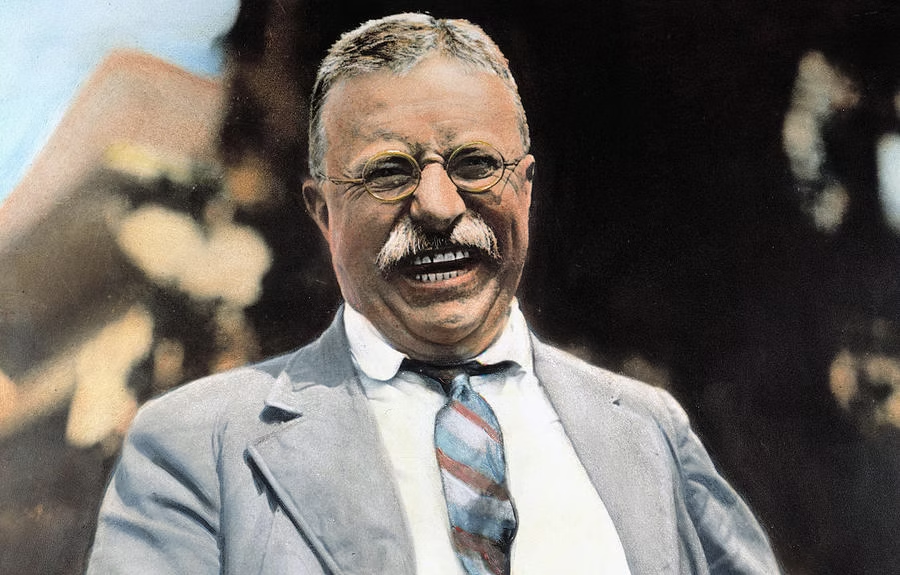
How Roosevelt Became the Most Interesting Man in America
Theodore Roosevelt is often regarded as one of the most interesting presidents the United States has ever had, and not without good reason. He was a cowboy, an adventurer, a hunter, a boxer, a naturalist, and a politician. But how did Roosevelt become such an interesting man? What drove him to do what he did, to be so adventurous, to become the man of action? In this post, we’re going to look at Theodore Roosevelt’s childhood, all the way up to his return from the Wild West. There is a reason that this man became the most interesting man in America. Let’s look at how he became that man.
Childhood
Theodore Roosevelt, or Teedie as he was called as a child, grew up in New York City. He was the son of another Theodore Roosevelt, a man who came from a rich family and inherited much of his father’s wealth. The Roosevelt family was well off and so never had any financial worries. His father decided to spend his time in public service and philanthropy, helping the poor and unable.
Teedie was a very sickly child. He regularly had asthmatic attacks, had bursting headaches, was physically very weak, and was regularly sick. It was so bad at times that his parents worried if he would even make it through childhood alive. Most of his sickness and headaches came and went, but the asthmatic attacks lasted into his twenties.
When he was 10, he and his entire family went on a trip through Europe, visiting countries like England, the Netherlands, Germany, Italy, France, etc. Teedie loved this, and it gave him something to distract him from his illnesses. They found out that good air and
being in nature helped to relieve the asthmatic attacks, so a trip to Europe did him very well.
On a later trip to Africa, he was given his first gun by his father, which is of course what every responsible parent would do. He used his gun to shoot birds, which he would skin and stuff, and collect in his room. From these trips to the wild landscapes of Europe, Teedie fell in love with nature, a passion that he has held ever since, which is exemplified in him being the creator of the first national parks in American history.
Education
Teedie was, because of his sickness, almost entirely homeschooled. He had private tutors teaching him, and he often also taught himself by reading all kinds of books. His private schooling meant that he was not used to going to class with other kids, something that would make him an outcast at first when he went to Harvard.
When he was 18 Teedie went to Harvard. He was let in mostly because of the status of his father, but also because he was a very bright kid. He was smart, even though he was privately and self-educated, and he picked things up very quickly because of his photographic memory, a gift with which he would often impress other people during his presidency.
Harvard was not a school that you got into because of merit, going to Harvard used to be only for the elite families of society, and lucky for Teedie, he was one of them.
He turned out to be a very good student, getting good grades, learning fast, and he even seemed to get along with most of his classmates. Eventually, he met his wife during his Harvard days, Alice Lee, whom he would marry later on.
But Harvard was not all good. During his time there, his father passed away from stomach cancer. Theodore, as he was now the oldest Theodore in the family, was devastated. His father was his idol, someone he wanted to be like. Everybody respected and admired his father, and he loved this about him. But he felt that he could not possibly live up to his father’s standards, and this would always be a driving force for the young Theodore Roosevelt, who, because of his father, always felt a chip on his shoulder. His time at Harvard was also the first time he went out to the Wild West, riding horses and living like a cowboy. During his trips there, he would often go very hard for very long, something his other ranchers couldn’t stand. This might have been something he did to test himself, but those who were around him often concluded that it seemed more like he was actually punishing himself. Punishing himself for not living up to his father’s standard, not doing what his father was doing. What we can take from this is that making his father proud and living up to his standard was a force that drove Theodore even after his father’s death, and is thus a crucial aspect of understanding the man.
After he finished Harvard, he went to Law school. He did this for only one year, after which he dived into New York politics, where he felt his real passion was.
Politics
The reason Theodore went into politics was something that was often his reason to do anything: his father. Theodore’s father used to help people who had less by providing them individually with help or working in small organizations to improve their lives. Theodore admired this, but he believed it to be futile. He felt like doing that kind of work wouldn’t really change anything on a large scale. His father’s work was still almost entirely in the hands of the people who made the policies, the politicians, and the governors; they were the ones with a genuine power to change things. Theodore realized this, and so to make a real impact on the lives of people who needed help, he would go into politics and make a real impact on his city.
Politics, however, was not something rich people did in those times. The rich often stayed out of politics, bribing some politicians here and there, but never making a real career out of it. But because of the wealth Theodore inherited from his father, he could pursue his passions without ever having to worry about making money, so his wealth allowed him to go straight into politics without any risk.
Tons of politicians however didn’t go into politics with the same intentions as Theodore. They were often in it for the power, the bribes, and the money, for which Theodore had no interest at all. Theodore was in it to make a change and better the lives of New York citizens, and that is what he tried to do.
One of the first big cases that Theodore had to vote on was the Cigar Bill. It was a bill that stated that cigars couldn’t be legally rolled in normal citizens’ own houses anymore. Cigar companies used to exploit their citizens by letting them roll their cigars in their own homes under terrible conditions for which they paid them pennies on the dollar. It was brutal, and the cigar bill was meant to change this, but Theodore voted against it. He believed in the constitutional right that businesses had the freedom to conduct their business as they
pleased, as long as it wasn’t illegal. But what Theodore wasn’t aware of was the terrible conditions these people were in. Until another politician, who explained to him that the Cigar Bill was positive, invited him to look at one of the homes where they rolled the cigars. Theodore, curious to know what was really happening, and not too arrogant to simply dismiss the invitation or make up an excuse, accepted. What he found upset him. He saw people working in houses that were way too small to house the families that were living there, with little children who were rolling cigars too, and rats flying by continuously. These conditions were horrible, and even if you didn’t look at how horrible these workers had it, the quality of the cigars must have been equally as bad, considering the hygiene of the workers. When Theodore saw this, he was instantly convinced and changed his stance. He would vote for the Cigar Bill and tried to convince others to join the cause as well. The Cigar Bill was rejected at first, but later on was passed anyway. While he didn’t contribute to the bill eventually being passed, this moment shows a very important part of Roosevelt’s character. It reveals him to be a man who is open-minded, who wants to know how things really are, not how he wants them to be. He doesn’t mind going with another politician to look at the real situation, even though he could’ve just said no. It also shows how much he cared for the people. Once he saw how bad they actually had it, he immediately felt that change was necessary.
Another early political moment that revealed some of his character and was a premonition for what was to come in his presidency, was the Westbrooke scandal. T.R. Westbrooke was a corrupt judge who was under the pay of one of the wealthiest and most powerful men in New York, Jay Gould. When Theodore heard about this corruption, he felt obligated to expose it. It didn’t matter to him that Jay Gould had all this wealth and power; corruption was not right, and should not be tolerated, no matter who does it. He wanted to fix New York, and he knew he was only going to do that by making some big changes and doing something others were not willing to do. Many people knew how powerful Gould was and simply ignored the corruption, but Theodore, a man of strong moral fiber, could not let something like that slide. Eventually, this project too would amount to nothing for Theodore; the scandal would fade away with time, and Gould would get away unscathed. But again, this shows something very profound in Roosevelt’s character. It shows us a man who is not afraid to stand up against a mighty opponent, it also shows us someone willing to do what others won’t do, and it shows a man who wants to do what’s right, no matter how great the risk may be. It reveals to us his moral character, that he does what he feels is right, no matter how great the odds or how alone he may seem in his battles. Even though he couldn’t make a real impact in politics yet, he showed in this period a side of his character that would be crucial to the president he would come to be.
Disaster
During his period in politics, his wife got pregnant. After nine months of pregnancy, Theodore received a telegram telling him that his wife was giving birth to a baby girl. Theodore couldn’t be any happier at that moment. But then, he received a second telegram, this one stating the worst news he would ever receive in his life. It said that his wife and his mother were both very ill and possibly dying, in the same house at the same time. Theodore rushed home and found both his mother and wife Alice alive, but not well. Both were breathing their last breaths. First, his mother passed away, she died of typhoid fever, a common but lethal disease back then, and in another room a little later, his wife Alice died of complications of childbirth.
In his diary that evening, the only thing Theodore writes down is one big X, with underneath the sentence: ‘The light has gone out of my life.’
Imagine how you’d feel if your wife died, then imagine how you’d feel if your mother died. Now imagine that they both died on the exact same day. Theodore would have had a very good excuse to fall into a deep depression and possibly throw his life away, but that was not him. He would get through this, even though he didn’t know how. So for the time being, he immersed himself in his work, something most people do after a very bad event happens to them to distract themselves. He simply immersed himself in work to not think about what happened. What is also remarkable, is that Theodore never used this moment as an excuse for failure, which he could have very well used it for.
In politics, his new project was that of choosing the presidential nominee for the Republican Party, and the only person he and his comrades didn’t want to be chosen, was James Blaine. A man whom Theodore and some of his party members despised, but was loved by most of the party. They went all out on a campaign to get the other Republican nominee elected. But Theodore failed, and Blaine was nominated as the Republican candidate for the Oval Office, a presidential race which he eventually lost. This, however, felt like another loss for Theodore.
Theodore felt like he needed some time to think. To reflect on his life, where he wanted to go, what he wanted to do, and he needed time to heal. His wife’s and mother’s deaths already took a toll on him, and combined with this great political disappointment, he needed a break from it all. He resigned himself to the wild west, at a place called the Bad Lands, in South Dakota, where he, with several other cowboys and ranchers, would build a cattle farm. His daughter lived with his sister Bamie, with Theodore telling others that his daughter would be better off without him anyway. He was at a low point.
Transformation
His time in the Bad Lands, as he would later describe, would turn out to be one of the best periods of his life, and exactly what he needed to recover his spirits. Cattle ranching was booming in the Wild West, and there was a lot of money to be made. So Theodore, with all of his wealth, bought a ranch and a bunch of cattle as an investment. Teddy already had a huge love of nature, and he really enjoyed being out in the wilderness in the Wild West. Of course, the West was adventurous, but that was also mainly because it was very dangerous. Predatory animals were everywhere, the land had not a lot of inhabitants and was thus quite solitary, and they needed to hunt if they wanted to eat. Theodore went on multiple hunting trips, shooting Elk and other edible animals.
On one trip, he noticed the footsteps of a grizzly bear somewhere in the mud. So being Teddy, he followed them, and eventually saw the bear somewhere in the woods. He got as close as he could to the bear, within 20 feet, as he said, and shot him straight through the
skull. He said that you could see that the bullet went right in between the bear’s eyes, something he was very proud of. This shows some of the physical courage Theodore Roosevelt had, being so daring as to stand face to face with a Grizzly bear, but it may also show his depression in a way. It’s likely that he wouldn’t have minded the bear killing him, feeling like he had nothing to live for anyway. Again, the risks he would take would be like punishing himself for not living up to his father’s standards, and for feeling like a failure. What mainly drove Theodore Roosevelt seemed to be his fear of being a failure and wanting to make his father proud.
His period in the Bad Lands did Theodore very well, he started to liven up again. He became much grittier and more muscular, gaining almost 30 pounds. Before he came to the Bad Lands, even with all of his training through childhood, he was still a scrawny figure, not like the big man as we mostly know him. This change in his physical appearance mostly took place in the Bad Lands.
What it also did, as was the intention of the ranch period, was give him time to think. During his time there, he wrote books about the adventures he had, such as one of the following adventures that shows how principled a man he was.
When, one day, a couple of men stole Theodore’s boat, he was furious. But getting the boat back seemed impossible and not worth the effort. Theodore didn’t have another boat to follow the perpetrators; he would most likely never catch up with them, and there was also a storm going on at the same time. This, however, would not stop Theodore, who felt like he needed to bring the criminals to justice, not because he needed or wanted the boat back, but simply out of sheer principle. “To submit tamely and meekly to theft or to any other injury is to invite almost certain repetition of the offense,” he felt. So he and his other ranch buddies built
another boat to chase the thieves. They went through stormy waters and were away for multiple days, but eventually, they caught the criminals. His ranch buddies would go home by boat, bringing the stolen boat back, and Theodore would walk with the criminals, getting home so he could turn them in. He walked 45 miles with them in less than 2 days, with no sleep. When he finally arrived, the sheriff asked him why he didn’t simply shoot or hang the thieves, to which Theodore replied that the thought had never occurred to him.
Stories like this show a man of moral standards, who believed in right and wrong, and that if you were wrong, you should be brought to justice, and he was not the arbiter of that justice.
But Theodore made up his mind, he would again endeavor into politics and make something of himself. This time, he was determined, and with all of his past experiences and trauma driving him, he had enough drive and motivation to succeed. When he got back from the Bad Lands, he was no longer young Theodore, the scrawny little kid whose life was a mess. But he became Theodore Roosevelt, a man of muscle and grit, who was determined to become a success. He left his past behind him and set his eyes on the future, with his goal: becoming President of the United States.