
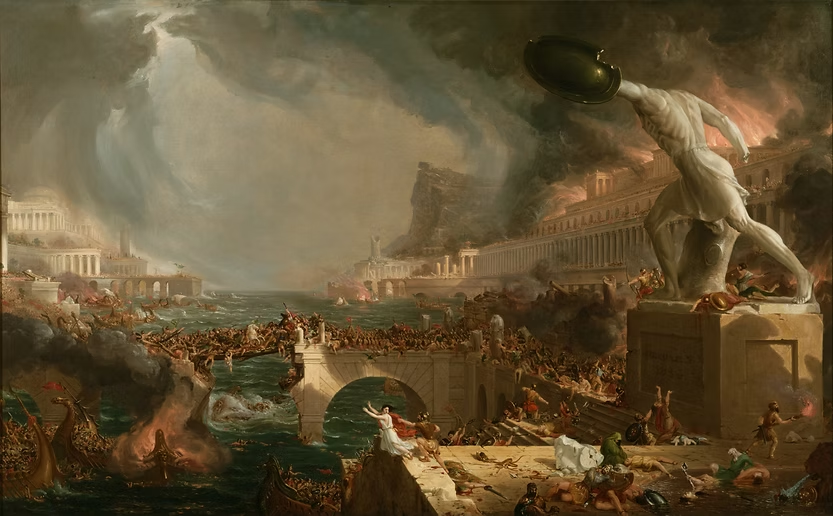
The 6-Stage Cycle of the Rise and Fall of Empires
Every great empire in history has known a period where it rose to greatness. But what every empire has in common as well is that it had a period of decline and eventually a fall. Everyone somewhat familiar with history is aware that each empire has its rise and fall, but not many know about how similar the process is for each of these empires. Throughout history, every empire had its own struggles, innovations, and culture, but despite these differences, on a macro level, the rise and decline of every empire is almost exactly the same. Every great empire follows a 6-phase cycle, which for every empire lasts for about 250 years, and the fact that this cycle happens to every empire is certainly not a coincidence. If you want to know how and why societies rise and fall, it is crucial to study these 6 phases so you can recognize them when they occur. Here are the 6 stages of empire as described by John Glubb.
Stage 1: Pioneers
The beginning of an empire is always marked by a period of outburst, a period which we call the ‘age of pioneers’. It is a time when a nation shows a tremendous amount of energy and courage and uses this to go after what it desires. At this point, these people often don’t have anything in a material sense, and this motivates them to acquire it. This provides them with a lot of courage because they have nothing to lose, and they have lots of energy because they are going after something they want. The result of this
combination of energy and courage is that they take action. They conquer land, loot, pillage, and steal, or they can settle in another empire out of admiration and eventually take over the bigger power from the inside, like the Visigoths and other barbarian peoples did before Rome fell. Either way, these people want what other powers have, and they have the energy and the courage to take the actions to get it.
An advantage that these new people have over the long-standing powers is that there is no blueprint that is holding them back. The older powers have laws, regulations, and traditions that put constraints on their actions and prevent them from experimenting with new ways of doing things. The new people do not have this problem. They often have no or little traditions, no laws, and no education in politics or tactics, but this doesn’t make them ignorant; instead, it makes them free. This freedom gives them the ability to experiment without any assumptions about the outcome. This gives them a ruthless method of trial and error, which is raw and directly informed by reality, and makes them able to think out of the box more easily and do things differently. By doing things differently, they become unpredictable to the older powers, which makes them dangerous, and so they are able to take over.
“Poor, hardy, often half-starved and ill-clad, they abound in courage, energy and initiative, overcome every obstacle and always seem to be in control of the situation.”
Stage 2: Conquest
After the period of outburst, the empire starts to expand its territory. It can do this in two ways. The first is to conquer smaller, less powerful nations and include them in their empire, like Charlemagne did for example in uniting Europe by conquering many different small duchies and bringing them under his rule. The second option is to invade powers that are larger and more powerful, but are in the latter stages of the empire cycle. This is what happened during the barbarian invasions during ancient Rome’s final moments. The expansion often continues until they arrive at a point where they have expanded their influence enough over a vast area to cement themselves as a huge power and practice trade and commerce in an efficient way.
During the conquering phase, one of the stimulants for territorial expansion is military expansion. Once a country expands its territory, trade and commerce will increase, and it will get loot from the lands they have taken. The result is that the country gets richer, and because it still wants to expand and get even richer, it spends lavishly on its military to conquer even more.
During the age of conquest, different nations and peoples are welcomed into the new empire. The multitude of cultures and territories stimulates commerce between different people, and goods will start to be traded on a grand scale. The occupation of trade starts to become more and more important and getting wealthy through trade becomes the aspiration of many citizens. This is when the next phase will begin.
Stage 3: Commerce
A direct benefit of the conquest of large amounts of land is the ability to drive more commerce. Different people of different cultures have materials that other cultures do not have. They can trade these commodities for other materials or money. So when a country expands territorially, trade expands as well. During this age of commerce, a nation gets very wealthy through trade, and prosperity is widespread. This is the phase where big building projects are set up, like Charlemagne did with his
cathedral at Aachen, or Athens did with building their Pantheon on the Acropolis. These projects can be fulfilled because there is enough money to produce them, and times are prosperous and peaceful. Developments in technology are also plentiful in this phase, resulting from increased contact with different people. New types of ships are built to increase commerce or improve the navy, new ideas are spread around the empire, and there comes a new emphasis on learning in general. This age is the absolute height of the empire. It is prosperous, wealthy, peaceful, and innovative.
But with this period of prosperity come also downsides. The main pitfall of this age is that money tends to become the sole object of people’s desire. A sense of honor and duty for one’s country is still there, but it starts to fade away, and the selfless quest for honor is replaced by the selfish quest for money. When people become more self-centered because of money, they are less likely to act in the best interest of the nation, but are more likely to act for the good of themselves or their wallets. This goes for businesses that want to make more profits instead of increasing the prestige or prosperity of the entire nation, but also for politicians who become corrupt and will sell their country out for money and power. Eventually, this focus on money and a nation’s prosperity reaches a boiling point, and that is when we arrive at the next stage.
“There does not appear to be any doubt that money is the agent which causes the decline of this strong, brave and self-confident people.”
Stage 4: Affluence
The age of commerce produces prosperity and wealth in the empire, but there comes a point where this wealth becomes a negative in many ways. One of the problems is one that started in the age of commerce but starts to become a big issue in the age of affluence, and that is the increased self-centeredness of its citizens. People don’t care about their country anymore; they don’t care that they see it is declining, or at least not enough to do something about it. They are more concerned about their life and their prosperity, and this becomes people’s focus. The object of a job stops being what is most useful for society, but becomes what job pays best. Students stop learning for the sake of learning itself, and they learn only to get the degree that gets them to the job that pays well. This self-centeredness and obsession with money lead to corruption within the state, a decline of patriotism amongst its people, and a decline in the solidarity and spirit of the country.
Another aspect of the age of affluence is the increasing defensiveness it creates. When the age of conquest was underway, aggressiveness was the motto. The empire actively fought against others and expanded its empire, keeping people busy, and keeping spirits up. But in the age of affluence, people stop wanting more, and they become afraid of losing what they already have. This results in a defensive attitude that spreads across the entire nation. They become pacifistic, not wanting to fight, and other upcoming nations can sense this. The great power that is unwilling to fight becomes the prey of the nations that are willing to fight, and their defensive attitude only invites more attacks and makes the great power liable to be conquered itself.
“Indeed the change might be summarized as being from service to selfishness”
Stage 5: Intellectuals
In the outburst phase, we have discussed the factors that contribute to the success of the new empire. Factors like courage, energy, and taking action all contribute to the achievement of success. During the phase of decline, the exact opposite factors are at play. The people get inactive and lazy, they are scared of change and decisive action, and they ponder over everything but take action on nothing.
After the age of affluence, money is abundant, and most people take all the basic needs of living like food and shelter for granted. Now they can go higher on the Maslow pyramid of the hierarchy of needs and start pursuing intellectual goals. Thinking becomes more important than achieving tangible
things in this society. Colleges, universities, and other places of learning become abundant, and the normal path for people becomes that of learning. In the age of intellect, there are enormous advances in technology and ideas, which will sometimes be used by other societies hundreds of years later, like the dialogues of Plato and Socrates, or the ideas about the universe of Copernicus.
The problem however with the age of intellect, is that the focus becomes thought rather than action. People will debate and think of new ideas constantly, but hardly anything is being done with those ideas. Politicians keep discussing what needs to happen every day, but decisive action as an outcome of these debates is rare. Problems are not solved but made worse by inaction, resulting in disaster and the continuance of the empire’s decline.
“Men are interminably different, and intellectual arguments rarely lead to agreement. Thus public affairs drift from bad to worse, amid an unceasing cacophony of argument. But this constant dedication to discussion seems to destroy the power of action.”
Stage 6: Decadence
When the age of intellectualism has arrived, great powers enter the next and final phase that seals their fate: the age of decadence. Glubb describes decadence as the disintegration of a system and not of individuals. When an individual member of a decadent society would get placed in an entirely different society that was not decadent, the individual acclimates to the new surroundings and would not remain decadent at all. So it is not a problem in the people themselves, but in the system they have created. Decadence is not a physical condition, but a moral and spiritual disease that has multiple causes.
The most important aspect of decadence is what happens within the great power. Political strife between individuals and parties becomes intensified and instead of working together for the good of the country, parties tend to hate one another and see each other as enemies. These internal rivalries become even more intensified when the nation becomes noticeably weaker, which only speeds up the decline. Instead of parties working together to save their nation, they fight one another, and the problems the country has do not get solved.
Another internal aspect that contributes to the decline is what Glubb calls frivolity: people are looking for pleasurable distractions to distract them from the decline. The citizens constantly look for entertainment, and the heroes of a nation stop being the great figures who built it, but become athletes, singers, and other entertainers. This frivolity goes hand in hand with a pessimism that occurs when people notice their nation’s decline. They feel like everything is going to hell, so we might as well distract ourselves with pleasure because there is nothing we can do about it. This frivolity and pessimism speed up the decline even more.
An aspect that hastens a nation’s decline that comes from the outside is the increase in immigration into the great power. The problem is not that one type of people is less or more of a problem than the other, the issue is that there are differences between the people that come in and the native inhabitants. In the first phase of a great power, the people in it remain relatively homogenous and this provides a feeling of solidarity in a group of similars. But after the age of affluence, foreigners are attracted to the wealth and conditions in the powerful nation and want to move there, often in great numbers.
There are several problems that will arise once a huge influx of foreigners floods a great power. Firstly, they differ from the natives simply in their basic human nature. The culture in that nation may be different and they may look at the world in a completely different way that clashes with the worldview of the nation they immigrate to. This creates tension within the society, even if all are loyal to it.
Secondly, when times are good, all people are equally loyal to the society they live in, but when times get bad, the immigrants will be less likely to sacrifice their lives or property for the good of the nation because the ties do not run that deep. This could be seen in Napoleon’s army when he invaded Russia. When France was powerful and they were on the winning side, everyone was loyal. But when things started to go bad on the battlefield, such as during his invasion of Russia, the foreigners in his army were the first to bail or sell out to the enemy.
Thirdly, the immigrants often create groups and factions within a society, still seeing themselves as a certain ethnicity instead of a citizen like every other. Because of this, they can prioritize their own interests instead of those of the nation, leading to problems.
The fourth issue is that the people who migrated to the nation often came from nations that were conquered or subdued by the great power. In the short term, when everything is well, they are good citizens, but when the decline starts to set in, suddenly the memories of the wars and abuse of their people come back, and movements begin to demand rights, reparations, or independence. This disrupts the unity of the great power in a time of decline, which will only speed up its fall.
The last point of a nation’s decline in a time of decadence is the emergence of a welfare state. This system is built on the idea that people who have less should be compensated so that they can get a good standard of living like everyone else in the empire. The intention of this is very noble and sympathetic, but the result is that the nation spends lavishly on this welfare state until the money runs out. When this happens, nations get into big debt, and economic collapse only remains a question of when.
All of these factors are involved in the decline and fall of the nation in a period of decadence. They happen at roughly the same time, and each problem amplifies the other. Immigration provides new people with totally different worldviews, which leads to political strife, and immigrants are often poor when they come to a country, which leads eventually to a welfare state. Frivolity is a result of political strife and problems of the decline that do not get solved because of it, and it results in people not caring about their country enough to save it, thus speeding up its decline. All of these factors together accelerate a nation’s decline until it eventually collapses under the strain of decadence.
“Decadence is a moral and spiritual disease, resulting from too long a period of wealth and power, producing cynicism, decline of religion, pessimism and frivolity.”
The original article by John Glubb can be downloaded below: