
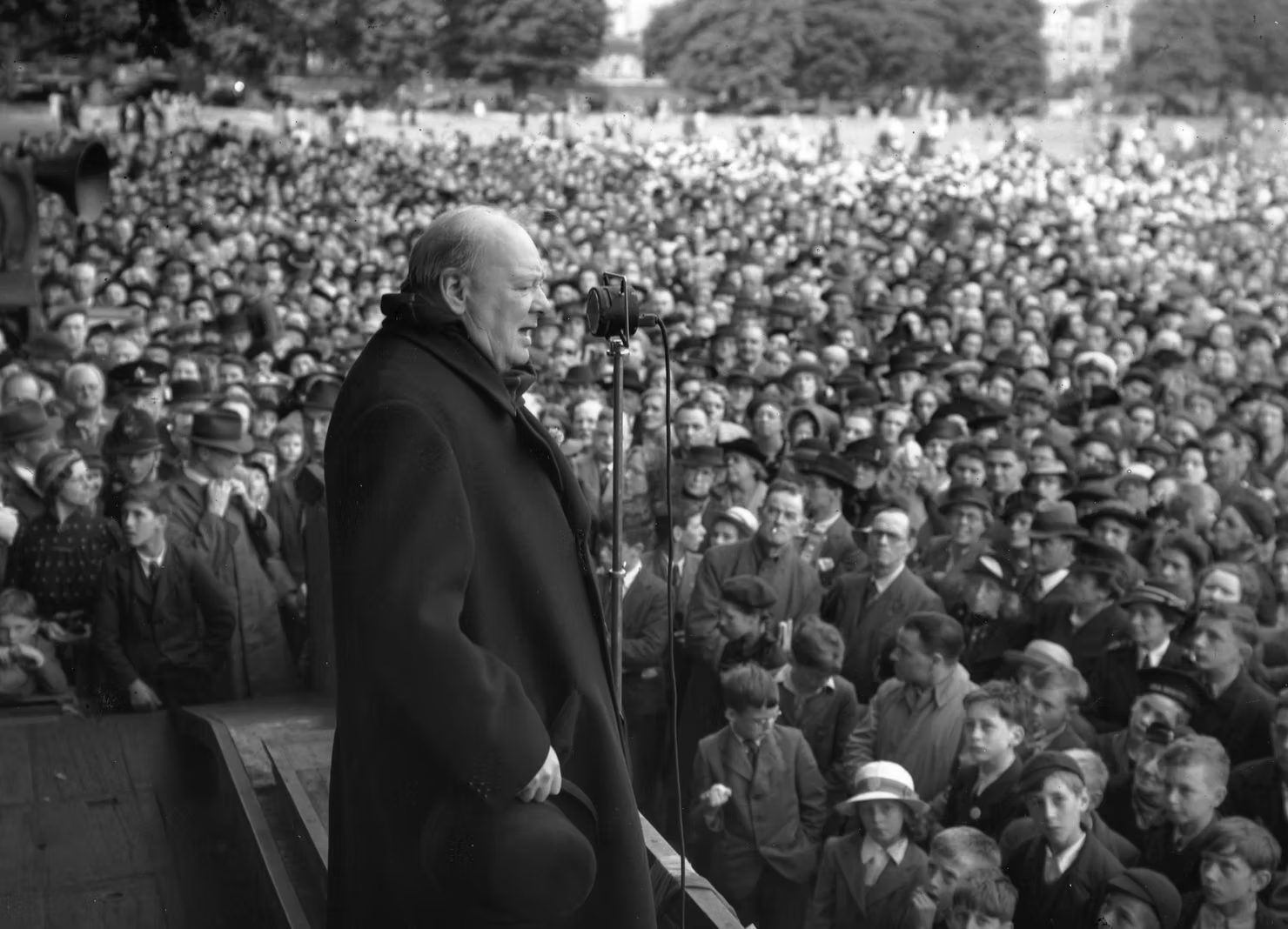
Churchill’s Principles to Master the Art of Public Speaking
Everybody knows about Winston Churchill’s wartime speeches and the inspiring effect they had on Great Britain during the Second World War. Iconic speeches such as ‘Their Finest Hour’ or ‘We Shall Fight on the Beaches’ are absolute masterpieces of oratory. But five decades before he even made those speeches, Churchill wrote an entire essay on the principles of rhetoric, principles which he has stayed loyal to throughout his entire political career. In it, he describes the five principles he used in every one of his speeches. Many people have the idea that the ability to speak well is a talent, but Churchill believes it is a skill that can be cultivated with principles to be mastered. In the ‘Scaffolding of Rhetoric’ he states that “rhetorical power is neither wholly bestowed nor wholly acquired, but cultivated. The peculiar temperament and talents of the orator must be his by nature. Their development is encouraged by practice.” Speaking well is a skill you can learn, but you can’t develop the skill if you do not know what you must learn. Churchill laid out the five most important principles of oratory in his essay that, if used correctly, will make your speeches invincible. Let’s go over them.
“Of all the talents bestowed upon men, none is so precious as the gift of oratory. He who enjoys it wields a power more durable than that of a great king.” ~ Winston S. Churchill
1: Correctness of Diction
According to Churchill, the most important aspect of rhetoric is to select the best possible word every time. The words you choose should convey your points in the most clear and understandable way possible. They should accurately describe what you mean so that there is no doubt about what you are trying to say, leaving no room for misinterpretation. Also, if the listener has to actively figure out what you mean instead of instantly understanding what you’re trying to convey, you will lose them and it will be hard to get them back into your argument after that. By choosing the correct words you’re making it as easy as possible for your listener to follow the argument and your audience will listen more because of this.
Another point is using the most understandable and simple language possible. It is of no benefit to use extremely complicated words that no one has ever heard of trying to sound smart. All this will do is disengage your listeners. If they can’t instantly understand your message and have to think about what you’re trying to say, they won’t follow your argument and will fail to receive your message.
An important aspect of this principle is the preferred use of short words whenever possible. Longer words are often more complicated, require more thinking on the part of your listener, and are often completely unnecessary. By using shorter words, the audience can effortlessly comprehend your message, avoiding the need to pause and ponder the meaning of each word.
Churchill also uses the argument that ’the shorter words of a language are usually more ancient. their meaning is more ingrained in the national character and they appeal with greater force to simple understandings than words recently introduced from the Latin and the Greek.’
These shorter words are what every longer word stems from, so it is often not necessary and even counterproductive to use long words when you can simply use a couple of short words to convey the same meaning, but be way more comprehensible. If you ever hesitate to use long or short words, always opt for the shorter ones.
2: Rhythm
The secret of great oratory lies in provoking an emotional response from the listener. He/she should feel what you are saying, and this can not be achieved by argument alone. One of the tricks Churchill uses to make his listeners feel the emotion he wants them to feel is by using the power of rhythm. Humans are absolutely powerless against the use of rhythm. Rhythmic sounds like music, for example, can put people in a truly trans-like state.
But rhythm is not something that solely applies to music. It can, and should, also be used in speaking. The way Churchill explains it is that your speaking should have a certain cadence to it, it should almost be like a sort of rhyme or poem that you’re reading out loud. When your audience gets caught up in your rhythm, they lose their ability to think and rely more on emotions, making them more susceptible to persuasion. Take Adolf Hitler as an example. He was a master at using the power of rhythm, and used it as a powerful and literally destructive weapon in all of his speeches. Even when he said things that didn’t make any logical sense, people still believed him and didn’t question it at all. Even though when you would logically show them these arguments, people would think they were appalling. He could make them believe what he wanted them to by making them emotional, and thus opening them up to his influence.
Emotion is the most powerful weapon of the speaker. When you can arouse the correct emotions in your audience, you can make them do and believe anything you want them to.
3: Accumulation of Argument
To persuade an audience, you have to take them from where they are now in their beliefs, to where you want them to go. This is why all of your speeches should be an accumulation of arguments, all heading towards the same conclusion. These arguments should logically build on each other, where the conclusion you’re heading towards gets clearer and clearer, and eventually, you powerfully close your arguments with a clear and logical conclusion.
As Churchill put it beautifully: ‘The enthusiasm rises. A series of facts is brought forward all pointing in a common direction. The end appears in view before it is reached. The crowd anticipates the conclusion and the last words fall amid a thunder of assent.’
You need the emotional part of your speech to be executed flawlessly, but to really seal the deal, you also need to perfect the logical side of your arguments. You can achieve a lot when you arouse the correct emotions in people, but when your argument is not understandable or doesn’t make any logical sense, there is a big chance that you will lose their attention either way. If you simply combine the use of the principles that arouse emotions in the listener with a consistent accumulation of logical arguments toward an understandable conclusion, then no one will be able to resist your message.
4: Analogy
The best way to make complex arguments understandable for your listener is through analogies. Analogies are used to make abstract concepts and thoughts understandable by relating them to something the listener already knows and understands. The analogy also gives some kind of proof for why your argument is true, because now you have something they can compare it to, something that occurred earlier and was similar, and it makes your argument that much more believable.
Analogies, metaphors, and stories are the most ancient ways humans have transferred knowledge to one another. Take the Bible for example, a book that is mostly a compilation of stories and metaphors with valuable lessons hidden inside them. Stories and experiences have always been the best way for humans to learn. You learn from your own experiences, but you often also learn from the experiences of others. Stories and analogies are a perfect way to transfer the knowledge of the experience of someone else to another person without them having to experience the event themselves. Analogies can exist in the form of stories, daily occurrences, or simply proverbs. A good analogy always provides a vivid picture or a sensory impulse to the listener. You want them to really imagine what you are saying to the point where they create a moving picture in their head.
Analogies also allow your listeners to believe that what you are saying is already known to them. The unknown information that you provide is simply an extension or a different version of what they already know. It shows them that what you are saying is not that abstract or unique at all, but is actually very similar to a concept that they are already aware of, they just haven’t made the connection themselves yet. But you are going to help them with that.
Churchill describes this as: ‘The ambition of human beings to extend their knowledge favors the belief that the unknown is only an extension of the known: that the abstract and the concrete are ruled by similar principles: that the finite and the infinite are homogeneous.’
5: Extravagant Language
The most important aspect of convincing people of your arguments and even inspiring them, as we mentioned before, is making them feel the emotion you want them to feel. One last element that is necessary to get the emotions of the listeners to the highest possible level, is using what Churchill calls extravagant language. This means using language that is full, powerful, emotional, and sometimes even bold. Words such as ’terrifying’, ‘disastrous’, or in a more positive manner: ‘incredible’ or ‘magnificent’, carry a strong meaning with a lot of emotion attached to them. Much more than say, ‘good’, ‘bad’, or ‘alright’. They may mean the same thing, but the charge of the word is entirely different.
As Churchill says: ‘The emotions of the speaker and the listeners are alike aroused and some expression must be found that will represent all they are feeling.’
It can’t simply be any emotion that you just toss into your argument. The emotion has to connect with what you’re trying to convey, and it has to make sense in the situation. Extravagant language is therefore best used to amplify an emotion. Instead of simply saying the situation doesn’t look good, you say: “It looks like there is no hope of us recovering from this situation.” The latter statement elicits a much stronger reaction and amplifies the negative emotion in this case that the situation doesn’t look good.
When you use all of the previous elements of oratory to arouse emotions such as rhythm and analogy, and you combine them with the use of extravagant language, you will maximally stir up your listener’s emotions. The idea is that if you make people emotional, they are much easier to influence, persuade, and inspire, and as a result your speech will be more effective than if it were mere argument. Logic makes people think, emotions make them act. If you heighten their emotions by using these principles, you make your arguments as effective and influential as possible. This power can be used for both good and evil. Hitler used these techniques for manipulation and destruction, while Churchill used them to inspire people to fight for a righteous cause. If you are a good person, and you want to help the world, then possessing this ‘gift of oratory’ is an absolute necessity.
“He understood that in the Victorian era of long political speeches he needed to entertain if he was to instruct, persuade and inspire.” ~ Andrew Roberts, Churchill: Walking With Destiny
Read the original version of ‘The Scaffolding of Rhetoric’ here: