
How Napoleon Rose to Power by Seizing Opportunities
His name is often mentioned among the greatest conquerors in history: Alexander the Great, Julius Ceasar, Hannibal, Charlemagne, Napoleon. But within this group of exceptional leaders Napoleon is particularly special. He went from being a nobody, born on a small island without any opportunities, to one of the most powerful people on the planet with one of the biggest empires in history. No historical figure has ever had such a spectacular and radical ascension to power as him, and probably no one ever will again. But even though Napoleon was a man of exceptional ability, without the opportunities to prove them, he wouldn’t have been able to achieve what he did. This post therefore is about Napoleon’s meteoric rise to power and how he did it, with a special focus on the characteristic that contributed the most to his success: his opportunism.
“Ability is nothing without opportunity” ~ Napoleon
Becoming a General
Napoleon Bonaparte grew up on the Italian island of Corsica. It was an Italian-speaking island on the coast of Italy that used to be under British rule, but just before Napoleon’s birth was sold to the French. Within the island of Corsica Napoleon knew he didn’t have any opportunities to satisfy his ambitions. He did, however, see his opportunities in France, where he went to a military academy and thrived.
Napoleon’s rise started right in the middle of one of the most tumultuous, chaotic, and violent periods in history: The French Revolution. It was a time of enormous civil unrest and societal instability in France. Many people were poor and, after a bad year of harvest resulting in famine, many didn’t have enough to eat. All this while the elite were living lavishly, even collecting more taxes to pay for the debts the French accrued during the Seven Years War and for their military support to the American Revolution. Eventually, the French people had enough, and it eventually reached a boiling point when violence broke out with the storming of the Bastille. People were upset with the absolutist monarchy that governed France, meanwhile they saw how a republic could function well when they looked at the American Revolution, and they wanted this too. At first, the king could remain in power but with it severely constrained, but after the king and queen attempted to escape, they were both executed for treachery by guillotine. This started a chaotic and dangerous period in France simply called ‘The Terror’, where over 16.000 people were sentenced to death by guillotine for ‘crimes against the republic’, which essentially meant everyone who disagreed with those in power, the Jacobins.
Generals and military leaders noticed the chaos like many others and fled the country as quickly as they could. The result of this was that they left a hole in the French military leadership, a role one man was keen to fill up. Because of this lack of generals and military figures and because of a pro-revolution piece he had written which showed his loyalty to the new republic, Napoleon quickly got promoted to being a general at an age that was very young for such a position at the time, and in normal, non-revolutionary times would have never been possible. Napoleon didn’t really have any strong feelings about the Revolution. He did believe in many of the ideas that stemmed from the Enlightenment that influenced revolutionary thought, but he was no radical in any way. He just saw an opportunity in the republic’s need for generals and he knew that if he joined their side it would help in his rise to power.
The first job he received as a general was to take back the city of Toulon. This was an important city to the revolutionaries from a strategic standpoint because of its harbor, and here he defeated the British, who had occupied the city, through brilliant use of strategy. He
was praised for this victory, but when the Jacobins lost their power in France and became enemies of the state, his rise stagnated and seemed over.
However, he got another assignment from the new republican government: subduing a Parisian mob protesting for a return to monarchy. These people were against the revolution and where it had gone and wanted to go back to the way things were and reinstate the monarchy. The revolutionaries would have none of this. Napoleon received this assignment because of his previous success at Toulon and the people in charge were confident that he could be successful again. So, he went to Paris with cannons filled with grapeshot and threatened the mob that he would shoot if they didn’t end their protest. They didn’t and so Napoleon gave the order to fire, successfully ending the riots. This instantly gave him a reputation of being a ruthless and cold general, but also as someone who was competent and could get the job done. Because of this, they gave him more campaigns. First to Italy, where he stole the show, then Austria, and eventually even Egypt. The success of these campaigns made him very popular with the French people, something he could make good use of later on. But the reason he was able to go on these campaigns was because he got the opportunities at Toulon and later in Paris and performed.
“Impossible is a word to be found only in the dictionary of fools.” ~ Napoleon
Coup d’état
The French people were discontented with the state of affairs after the revolution was over. The Directory, the newly installed government, was seen as dictatorial and not looking out for its people. The economy was worse than ever, the government didn’t have any money to spend, and inflation was through the roof. There needed to be a change in government, but who could provide it?
After his many victorious campaigns at Toulon, Italy, and Austria, Napoleon was a beloved figure by the French people. Only his campaign in Egypt turned out to be a failure, but through clever propaganda, the public perception of this campaign was fairly positive. His popularity skyrocketed through his victories, but also because of his charismatic personality and his ability to persuade and inspire. He noticed that this was the opportunity of a lifetime to take power. The people would readily accept them as their leader because of the bad leadership from the Directory and because he was massively popular among the French people. So, together with a few others, he staged a coup d’etat. He walked into the assembly
with armed soldiers and ordered the government to resign. They did, and Napoleon took the position of First Consul, effectively making him the sole leader of the French Republic.
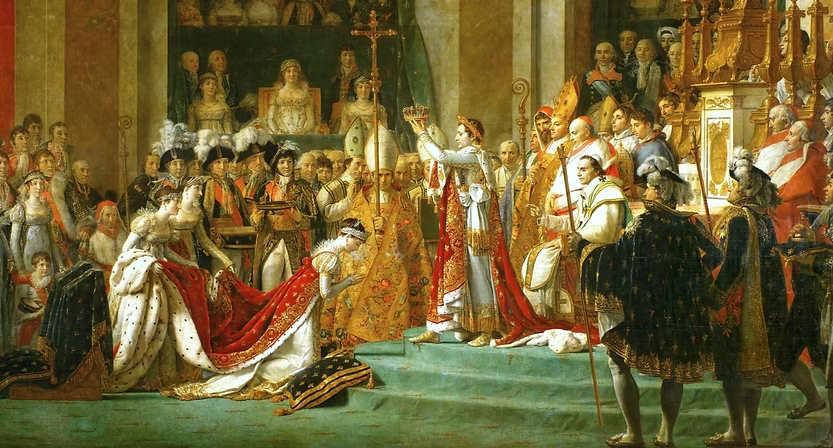
But being First Consul didn’t satisfy Napoleon’s gigantic ambitions. He wanted more, and he found the perfect opportunity to achieve it. Because there were numerous plots attempted to take his life (he wasn’t popular with everyone), Napoleon needed to appoint an heir for if they might succeed. If he had no heir, a power vacuum would remain after his assassination, bringing enormous uncertainty and chaos. He didn’t want to take that chance, so he decided that he needed to be appointed emperor so he could officially appoint an heir. He put it to a vote: Do you want Napoleon to be emperor, Yes or No? In a totally fair and unrigged election, 99.93% of France was in favor of him becoming emperor. Though this was of course not the real result, most people would have been in favor. With this ridiculous number, Napoleon simply wanted to show that he had the French people’s unanimous support to be emperor. Napoleon crowned himself, instead of being crowned by the pope, as had usually been the case throughout history mostly because he disliked the Vatican, but some people see it as a metaphor that he didn’t receive his powers from God, or even that he thought of himself as a god. Though these are probably untrue, it is interesting to speculate.
So, within a couple of years, Napoleon went from a nobody from the small Italian island of Corsica, to a successful general at 24, to being emperor of the French at just 34 years old. Within a period of ten years, he became one of the most powerful people on the planet, something that has never happened before in history, and his ability to spot and make use of opportunities played a big part in making this happen.
“Everything passes rapidly on earth, with the exception of the mark we leave on history.” ~ Napoleon
Geef een reactie