
How Napoleon Came to his End and Misconceptions About his Downfall
Napoleon is one of the greatest figures in human history. His rise to power was spectacular, but what was just as if not more spectacular was his downfall. There have been many reasons ascribed to the downfall of the Emperor. Did his empire fall because of his ego? Did he have a Napoleon complex, as it is now called, or did his delusions of grandeur cost him his crown? In this post, we will look at Napoleon’s downfall, how it happened, and especially why it happened. It will show you that it was not because of the usual reasons that are mentioned for his downfall. He didn’t have delusions of grandeur, and he certainly did not have a Napoleon complex. We start our journey where the first indication of his downfall occurred: the Peninsular War.
The Peninsular War (1808)
Napoleon’s downfall began when he decided to invade Spain and Portugal, or as it is called, the Iberian Peninsula (which is where the name Peninsular War comes from). Spain and Portugal were allied with the British Empire and were still trading with them, something Napoleon didn’t want them to continue doing. He wanted to impose a trading blockade on Britain stretching the entire European continent in order to weaken the British economy and fight England in an economic instead of a military way. He had implemented the trading blockade over almost the entire European continent at this point, but the only nations still trading with Britain now were Spain and Portugal, so he intended to go there to make sure that they wouldn’t and invaded the Peninsula. At first, everything went remarkably well, they stormed through Spain like it was nothing and quickly reached the capital. The French believed that if they’d just take over, overthrow the monarchy, and put a Frenchman on the throne, the Spanish people would simply accept it. Unsurprisingly, that is not what happened. The Spanish people revolted and started exacting guerrilla warfare on the French army. This form of warfare was brutal and was carried out not by a military force, but by ordinary citizens. The Spanish people weren’t going to let Napoleon take over Spain without a fight. This form of guerrilla warfare worked so well and was so effective that it brought serious damage to the French army.
His Spanish campaign, known as the Peninsular War, was the start of his downfall for several reasons. It weakened his army and his position in the eyes of his allies, and made sure that some troops had to stay in Spain to ease the situation while Napoleon decided to invade Russia, which meant he didn’t have access to all of his troops and generals that could have been very useful to him in Russia. But next up is the most important and well-known event considering his downfall: His invasion of Russia.
The Invasion of Russia (1812)
The Russian invasion was one of the bloodiest and most gruesome campaigns in world history, and an absolute disaster for Napoleon and his army. Tensions between France and Russia started arising after Napoleon found out that his deal with Russia to not trade with Britain wasn’t being honored. He was furious about this and ordered the Russians to rejoin his trading blockade. Tsar Alexander wouldn’t do that, so Napoleon decided to intimidate the Russians into complying by invading their country. So with more than 600,000 troops, the largest amount in history up until that point, consisting of French, Austrian, Polish, and Italian soldiers, he marched off to Russia. When he first entered Russia, his invasion seemed to go according to plan. He defeated the Russians at every battle and they would retreat every time. Eventually, he arrived at the town of Smolensk where he set up camp. The Russian winter was coming and most of his generals believed that they should wait it out and move again when spring would arrive. But Napoleon noticed an opportunity, as he did so often. He saw that he could just march on straight to Moscow and take the Russian capital. This would provide him and the French with a solid place in the history books and a ton of status and glory. With most of his generals in disagreement with his decision, Napoleon decided to march to Moscow, but what encountered when they arrived was something they couldn’t have imagined. The whole city was up in flames and emptied out. The great city of Moscow was a complete ghost town. This was all a deliberate plan from the Russians; they abandoned Moscow, freed all of its prisoners, and ordered them to commit arson all over the entire city. This way when the French would arrive, they’d have no supplies, there’d be nothing to steal, and Napoleon did not get the glorious victory he had hoped for whatsoever.
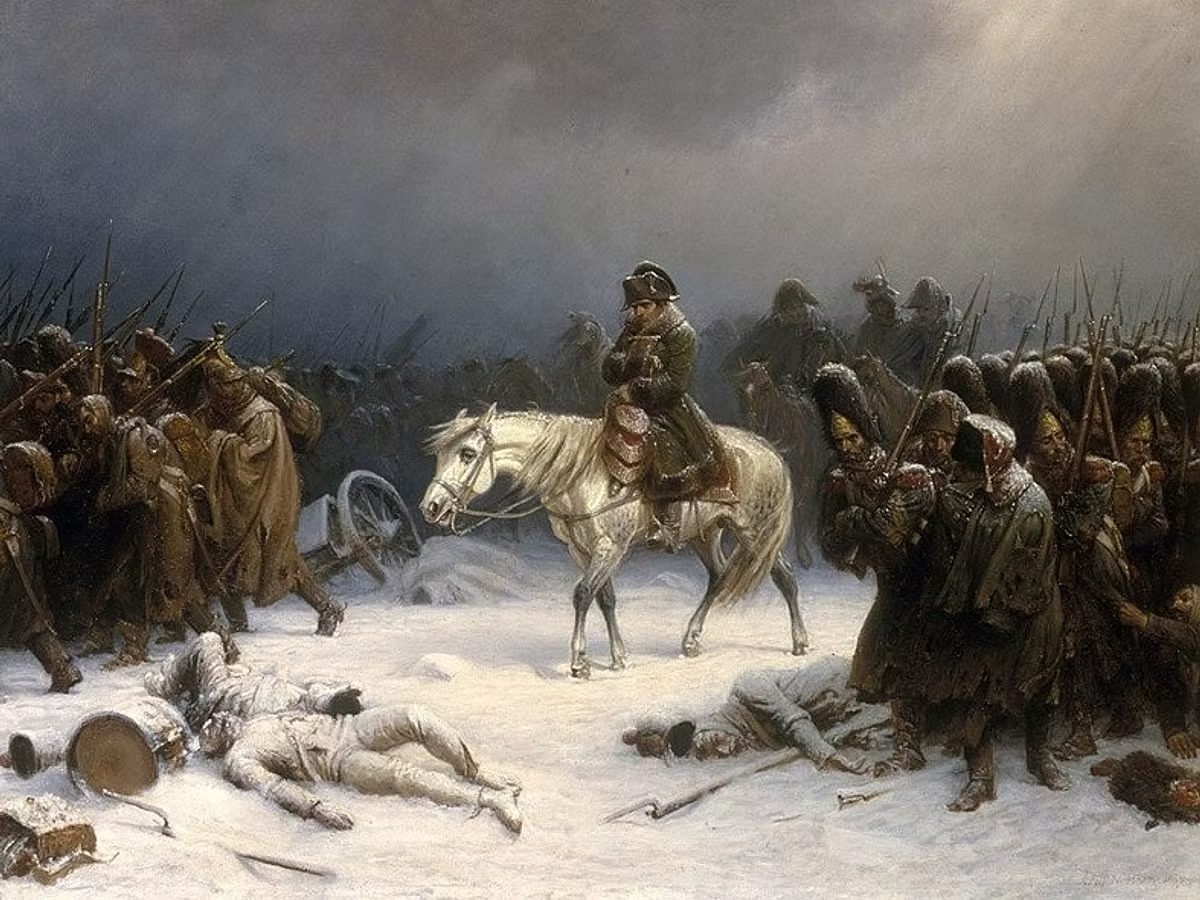
What Napoleon didn’t know was that his march to Moscow was extremely advantageous to the Russian army. When winter came and supplies ran out, Napoleon finally saw the need to retreat from Moscow and get back to their supplies. What he didn’t realize was that the Russians were coming in on his sides and attacked him from his flanks on his way back home. Numerous battles took place during this retreat from Moscow back to Smolensk with many casualties, but what was worst was not the fighting, but the weather. Russian winter had arrived, and it was excruciatingly cold. On some nights temperatures could be as low as -35 degrees Celsius. This coupled with the fact that they didn’t have adequate winter clothes for this occasion meant that most of Napoleon’s men froze to death and died of hypothermia. There also was almost no food left, so numerous of his troops died of starvation too. From the 600,000 men who marched into Russia, only around 100,000 came out. It was a bloodbath, and the end was near for Napoleon. By losing so many men, and having a campaign that failed so disastrously, he was in a very weak position when he returned, and his empire was essentially crumbling apart. While Waterloo was seen as the end of Napoleon, it was more of an official ending. His real end was when he returned from Russia.
Waterloo (1815)
After his abdication and return from the island of Elba, Napoleon was welcomed by many of France’s citizens, and especially by many of the troops who had previously fought with him. On his march towards Paris from Elba, he even apparently told his troops: “If there is one among you who wants to kill his general, his Emperor, here I am.” After which the troops started to cheer and marched alongside him to Paris. When he returned, England, Prussia, Austria, and Russia were gravely concerned. They were of the opinion that Napoleon was an outlaw and a danger to world peace, and needed to be defeated. The final battle was eventually decided near the village of Waterloo in Belgium, where Wellington with his English army, stood against Napoleon’s Grande Armée, which after his abdication was not so Grande anymore. Napoleon had a little more troops than Wellington when the battle began and rightfully believed that he had a good chance, the battle was certainly not hopeless. The only problem was that the Prussian army was also on its way to join the English army at Waterloo. If they did, he would be significantly outnumbered, which would mean certain defeat. Napoleon had to act quickly if he wanted to win, he had to destroy the English army before the Prussians arrived.
During the battle, Napoleon came close to winning a couple of times, there were moments when he could have broken through the center line of the English and done some serious damage, but eventually, these attempts failed. Partly because of how untrained his troops were, also the generals who were in wrong positions or good generals that were simply absent, and a couple of terribly consequential miscommunications, Napoleon couldn’t defeat the British army before the Prussians arrived. When they arrived, Napoleon’s situation was hopeless, and after a little more fighting, the battle was officially over and Wellington, the commander of the British army, was seen as the hero who had beaten Napoleon once and for all. Napoleon fled back to Paris, where the English arrived shortly after to once again exile the man to a remote island. They were afraid that if they executed him, which would have been an option, they’d only make a martyr out of him and cause chaos in France and Europe, so eventually, they settled for a one-way trip to the island of St. Helena. This is where Napoleon lived out the rest of his life until he died. Eventually, due to political reasons, his remains were brought back to Paris, where Napoleon got a beautiful tomb in L’hotel des Invalides, which used to be a hospital for the military. A place where he probably would have loved to be buried, alongside his men.
Misconceptions About Napoleon’s Downfall
1 – He was a Warmonger
One of the main criticisms made about Napoleon is that he was a warmonger who sought out wars with every country that caught his eye. Though this may sound accurate, considering that Napoleon’s entire adulthood he has almost constantly been at war, it is not. The fact is that in total 9 different wars were fought during the Napoleonic wars, of which only 2 (the Peninsular War and the invasion of Russia, his two biggest mistakes) were started by Napoleon himself. This means that most of the wars were not started by him, though he did finish most of them.
The first war he fought with France was one that had started before he was a general. Countries that still had reigning monarchies such as Austria, Prussia, and England were afraid that the ideas of the French Revolution, in which the French people overthrew their monarchy, would spread to the rest of Europe and cause trouble in their monarchies. What they wanted was to get rid of the democratic government that was installed after the revolution and reinstitute the monarchy. To achieve this, they went to war with republican France. Of course, France fought back and lost most of its battles at first. But when Napoleon seized the town of Toulon and threw out the English, the French got some renewed hope. Now France decided to attack Austria from the entire right flank of France. On the upper half near Austria and Germany, some French generals fought but hardly made any progress. But then there was Napoleon fighting at the bottom in Austria-controlled Italy, who won battle after battle and eventually conquered the entire region of Italy. Because of Napoleon’s staggering and unexpected victories, Austria sued for peace and the first war was over.
The rest of the wars brought upon Napoleon were mainly instigated by the British who wanted him gone. He was a disruptor in Europe and he was bad for the English trade. The English formed several coalitions against him with other countries that included mainly Austria, Prussia, and Russia. One of these coalitions eventually beat him at Waterloo.
But almost all of the battles with these coalitions were won by Napoleon. Every time Napoleon immediately went for the peace deal, and during these periods there were temporary times of peace in between the Napoleonic wars, but after a while the other countries continually decided to wage war against Napoleon, despite his best intentions to maintain peace.
The only times when Napoleon himself declared war was during the Peninsular War, in Spain and Portugal, and his attempted invasion of Russia. With the Peninsular War, it was more about stopping the English trade at their harbors and not so much about Spain itself. As we discussed Spain turned out to be a disaster for Napoleon because of the unwillingness of the people of Spain to be conquered. His invasion of Russia also came out of an attempt to damage the economy of England. With one of his peace deals, Napoleon negotiated a settlement with the countries of Europe, including Russia, not to trade anything with the British. But when Napoleon found out that Russia kept on trading with England, contrary to their agreement, he took it as an insult and as a way of Russia saying, we don’t care about your agreements, and in an attempt to intimidate the Russian Tsar, he decided to invade. His original plan was to inflict damage on Russia, and then negotiate another peace deal, but as we’ve seen the invasion went way further than planned and essentially resulted in Napoleon’s downfall.
Whereas Napoleon did like wars, and won almost all of them, he didn’t start most of them, and the ones he did start were essentially because of a war he already had with England. So is Napoleon a warmonger who only wanted war? No, he wasn’t. Was he a military genius and very good at war? Yes, he was. But this doesn’t necessarily mean that he looked for conflict with others, in fact, history tells us the opposite is true.
2 – Invading Russia was Impossible
Many people claim that Napoleon’s invasion of Russia was based on delusions of grandeur, that he thought he could easily invade Russia because he was Napoleon and was just better than everyone else. This, however, is not true at all. Napoleon’s invasion of Russia was much more calculated than people believe, he simply made a couple of mistakes and didn’t expect the Russians to go as far as they did.
The idea was, as we discussed, to go into Russia a bit, fight some battles, win them all, and force Tsar Alexander to sign another peace treaty. Napoleon also had plenty of reasons to believe that he would be successful in this. He had the largest army ever seen at that time, bigger than the one Russia had. Although this may seem like a huge advantage, in a way it wasn’t. Many of his soldiers came from the coalition he had with Austria, Prussia, Poland, and Italy. This meant that he had tons of people fighting for him who were not emotionally invested in France and its success. So when France was on the losing side in Russia, many soldiers just switched sides. This made Napoleon’s Grande Armée even weaker and sped up his losses.
His first idea was to march into Russia and force a peace treaty, but the Russians did something that Napoleon didn’t expect at all. With every battle, the Russians retreated. They did this several times, and each time Napoleon moved up into the mainland of Russia until he eventually reached Moskow. Going to Moskow was not a battle strategy, but a power strategy. The idea was that when he conquered Moskow, everybody in the world would know who Napoleon was and what he did, and as a bonus the Tsar had to sue for peace. But what happened was something that nobody expected.
When Napoleon arrived in Moscow, the entire city was completely empty. Everybody had fled. When Napoleon decided to go to sleep (which he did in the Kremlin) he woke up to something that surprised and horrified him. Moscow was up in flames. At first, he asked his generals who did this, and they told him that the Russians themselves did it. He couldn’t believe that the Russians would burn down their own capital, so he thought his generals were lying or covering something up. But after asking another time, he noticed that his generals were serious, and they themselves were flabbergasted as well. What the Russians did when they fled the city was release Moscow’s prisoners, and give them the task of committing arson in every part of the city.
What the Russians did was set Napoleon up for slaughter. They lured him deep into their country, and when he was deep enough, they were able to surround him. Napoleon planned to wait the winter out in Moscow and then return to France, but because of the arson, and because food supplies started to run out, Napoleon had to return, in wintertime. His return to Smolensk was disrupted multiple times by Russian armies coming from the side. But what was even worse were the terrible conditions the Russian winter brought. More soldiers died of starvation, diseases, and hypothermia than by any contact with the enemy. The Russian campaign eventually ended in a bloodbath, where Napoleon lost most of his men.
Even though invading Russia in hindsight was the worst decision Napoleon ever made, it was one that made sense when he made it. His army was larger, he could’ve gone back before winter arrived had he stopped at Smolensk, he believed that the Tsar was willing to make peace, and he never expected the Russians to just give up cities, including Moscow, in order to lure him in and surround him. This doesn’t mean that this terrible disaster was not his fault, but it does show that Napoleon knew what he was doing when he waged war with Russia and was not just on some power trip trying to conquer the whole of Russia. He simply wanted peace, but what he got was humiliation.
3 – The Battle of Waterloo was Pointless
Another point made about why Napoleon was a megalomaniac was that he fought an unwinnable battle at Waterloo and that because of him enormous amounts of soldiers lost their lives for nothing. While this may seem like a decent point to make, and indeed the loss of life turned out to be senseless, it is neither accurate nor complete. While it may have seemed in hindsight an impossible battle to win, it really wasn’t. Napoleon had ample opportunities to win the Battle of Waterloo, and he came close to victory a few times. While Wellington seemed very confident in victory, he too admitted after the battle that the English had some close shaves with defeat. If Napoleon had burst through the center line with his army when Prussia hadn’t caught up yet with Wellington’s army, Napoleon may well have defeated the English, which would have made it possible to also defeat the Prussians. Napoleon’s idea was when he’d done that, he’d sign a peace deal with the allies and just rule France again as its Emperor. The plan for Waterloo was not doomed to fail at all, but Napoleon took a calculated risk. Sadly for him, through miscommunications, generals in the wrong positions, and bad weather, the battle resulted in a loss for Napoleon and the end of the Napoleonic era.
4 – Invading Spain was Expansionism
Lastly, we have one of Napoleon’s biggest mistakes he ever made besides invading Russia, his invasion of Spain. Spain is often cited as an example of Napoleon’s desire for power and is perceived as a simple land grab. This however was not the case. Invading Spain was a tactical decision, based on his war with England. Napoleon planned to destroy the English economy, mainly because war at sea was unwinnable against the English, and he would do this by closing off trade with the European continent. This worked quite well, and most of Europe didn’t trade anything with England for a while, but Spain was not under Napoleon’s control and kept trading with the English. To put the icing on the cake and prevent further trouble, Napoleon decided to invade Spain and also implement his trade ban in Spain and Portugal.
This, however, didn’t turn out quite like he’d hoped. The Spanish strongly resisted Napoleon’s invasion and did this with a new style of warfare at the time: Guerrilla warfare. This was not a war of army against army, but it was regular citizens and resistance groups against the French army. This was a form of warfare Napoleon never could have suspected, and if he did he certainly wouldn’t have expected it to be this effective. After the Spanish put up a good fight against the French, even the English decided to join them. Eventually, this turned out to be a complete disaster for France, and they lost a lot of men in that war. Also, the Peninsular War overlapped with Napoleon’s Russian invasion, which meant that while he was busy invading Russia, he still had to pay attention to what happened in Spain, and most importantly of all, he had to still send troops out there, which meant he couldn’t go all out on Russia.
His campaign in Spain eventually failed, but the reasons for his invasion were not as nonsensical as everyone likes to believe. It was not simply ‘land grabbing’, or a desire for more power and to expand his empire. It was a very logical decision to make in a trade war with England. Had he succeeded in conquering Spain and Portugal and blocking all English trade there, he could have genuinely damaged the British economy and perhaps even won the trade war after all.
What this post is trying to prove is that Napoleon wasn’t the megalomaniac with a giant ego who had to compensate with bullying behavior for being short. There is much more to the man than meets the eye, he was a very complex and also genius figure in many ways. His downfall was mainly because of mistakes he made and bad luck, not just because of grandeur or because he believed he was unbeatable. Napoleon may have been reasonably small when it came to his height, but in the light of history, he was undoubtedly a great man.