
How Dystopian Fiction Starts to Resemble Reality
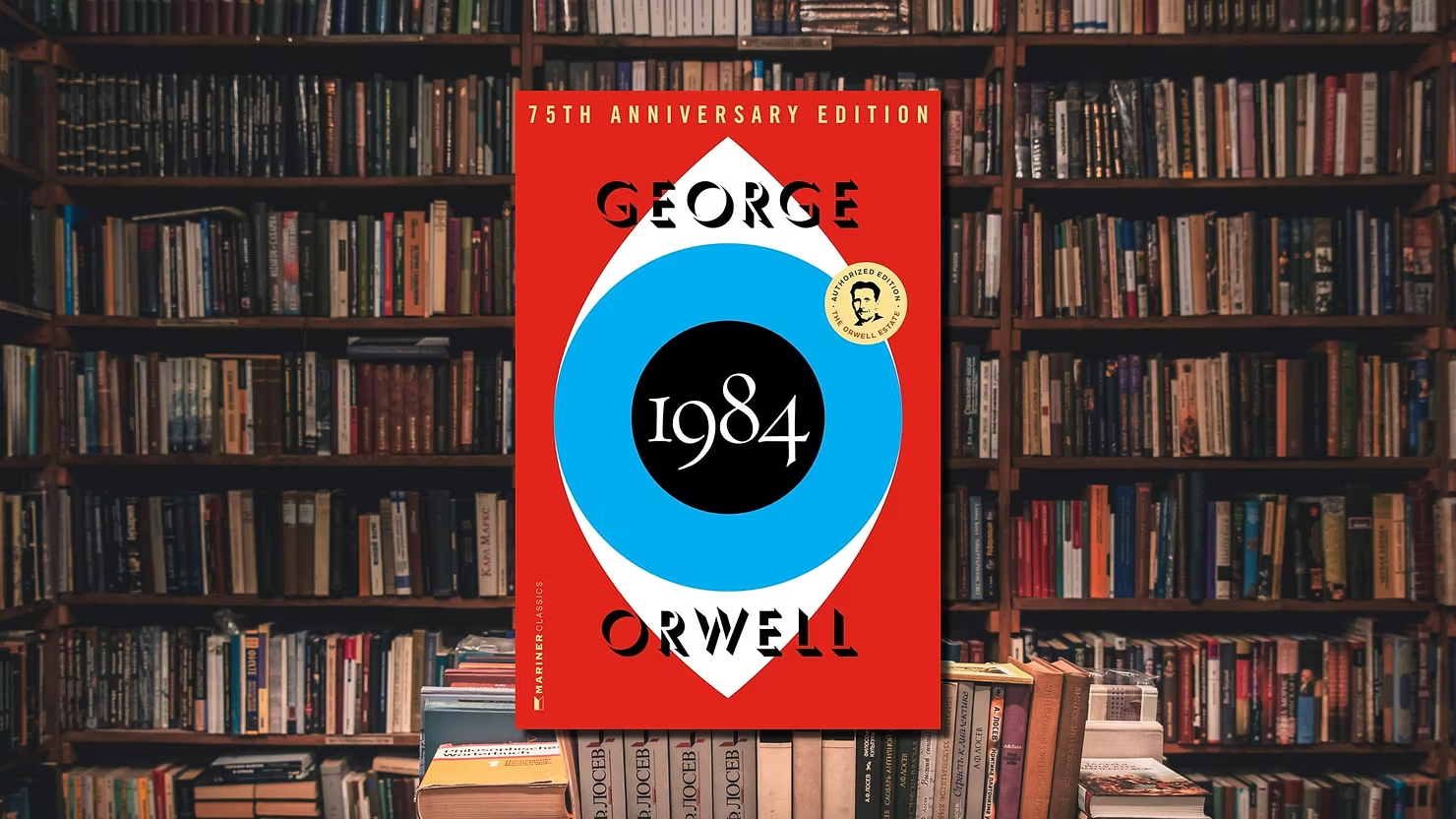
Fictional dystopian novels used to be just that, fiction. However, it is frightening to see how much these fictional novels seem to be resembling reality more and more. People don’t think for themselves anymore and repeat what they’re told, censorship has become commonplace, and privacy is a thing of the past. All of these issues come to the forefront in George Orwell’s novel, 1984. The story is about Winston, a man who lives in a dystopian society where everything is decided by the Party. Speaking out against it is not allowed, privacy doesn’t exist because Big Brother is always watching you, and everyone has to believe the lies they are told by the Party. Let’s take a look at what these concepts are in the book and in what way they resemble our realities today.
Dystopian Fiction
Doublethink
One of the most important concepts in the book which every citizen of Oceania has to practice is doublethink. The idea of doublethink is holding two contrary opinions at the exact same time without being bothered by their contradiction. You switch between these ideas depending on which is more suitable for the occasion and you forget the other contrary idea. When the contrary idea is more suitable however, you use the other idea and forget the former. The prime examples named in the book which are constantly propagated by The Party are WAR IS PEACE, FREEDOM IS SLAVERY, and IGNORANCE IS STRENGTH. As you can see, these words are as contradictory as they can get, being practically polar opposites of each other. However, the citizens of Oceania are forced to believe these statements are reasonable and true.
Doublethink forces people to ignore their own eyes and ears, and even their own thoughts. When the Party tells you that the country is at peace, you must believe it even if you can see with your own eyes that they are at war. By conditioning the people of Oceania to accept ideas that do not match reality, they can manipulate what people think, and therefore they can manipulate their perceived reality. If people can’t think for themselves, they have to blindly believe and act on what the party tells them.
Another consequence of doublethink is that people become desensitized to having these contradictory beliefs. Having two beliefs that directly contradict each other is absurd, and so they are conditioned to accept and believe any absurd thing the party tells them. They can tell them to believe the dumbest and most absurd things and they will swallow them, because they’ve been conditioned to swallow them.
Newspeak
Parsons, an acquaintance of the main character Winston, is busy working on the newest version of the newspeak dictionary. When he talks to Winston in the canteen, he can’t hold back on how excited he is for this new version of the dictionary. It will be so much thinner than the previous version, and so many ‘unnecessary’ words will be pruned from the previous version. When this version is finished, the language will be perfect.
Newspeak is a crucial concept in the story of 1984. The main goal of the implementation of Newspeak is for the party to control the thoughts of the citizens, even making thinking outside party lines a ‘thoughtcrime’. However, it is quite difficult not to make people think something, unless you can make sure that they can’t say it. Because when you can’t say what you think, you can’t spread your ideas to other people. As a result, the thoughts and beliefs you hold will perish with you. Perhaps you’ll even forget what you believe to be true yourself after years of not speaking those beliefs or hearing anyone say them. When you control what people say for a long enough period of time, you can control what they think. That is the reason that the party wants to change the language from English to Newspeak: thoughts are easier to control.
Words like very good or excellent, in Newspeak get to be ‘plusgood’, or ‘doubleplusgood’. A word like bad becomes ‘ungood’, making it have less of a negative connotation. What these words do is not only make the language simpler, but they also restrict thought. When you have fewer words to use, you have fewer ways to construct your thoughts, and when regular words like ‘bad’ disappear and get replaced with a version that refers to less good, the whole idea and the way you think change.
Big Brother
When Winston enters his house, the first thing he sees is a poster plastered on his living room wall. It is the picture of a man with an intimidating and serious face with a dark black moustache. Underneath it stands the phrase: ‘Big Brother is Watching You’. When Winston has to go to work in the morning, he walks through the hallway of his apartment building, surrounded by more posters: ‘Big Brother is Watching You’. When he gets to his work at the Ministry of Truth (the ministry that spreads lies), he sits down at his desk, right in front of a television screen with Big Brother’s face on it. Big Brother is everywhere. He sees everything, he knows everything, and he controls everything. Privacy is no more, because Big Brother is watching you.
Big Brother is almost certainly not a person. He isn’t a man who is watching everyone at the same time. That’s also not the point of him. Big Brother is the embodiment of the party, he is the face of it. People are conditioned to love Big Brother, this is because people can’t directly love a group or a party. They need someone, a person, to direct their energy towards, in this case that person is Big Brother. He is seen as a god-like figure, higher than man, infallible, and larger than life.
The people of Oceania are forced to love Big Brother. If they love him, they will love the party, because Big Brother is the party. This way, the people will do everything that the party tells them to do. When Winston is tortured near the end of the book, after confessing to all of his crimes, and even admitting that 2+2=5, he needed to do one last thing for him to be allowed back into the world. He needed to love Big Brother. At the end of the book, he did.
Dystopian Realities
Doublethink in Real Life
One of the key methods of control in 1984 is the concept of doublethink, which is holding two contrasting opinions at the exact same time, and being able to pull one idea out when necessary and forget about the other. Outside the book, these mental gymnastics are also often used by people today. They believe one thing that directly contradicts another belief they hold. This is often the result of people carelessly repeating what they are told by someone or something, such as a newspaper or a TV personality. The opinions these people have are not their own, and they haven’t thought them through. As a result, when you try to challenge them they may fall back on an opinion that directly contradicts their previous opinion because they haven’t actually thought about it very carefully. These are the most harmless types of doublethinkers; they are simply ignorant and don’t know much about a subject, but don’t want to look dumb, so they pretend they know about it by carelessly repeating what someone told them.
It can also be more malignant when opinions are formed because they ideologically align with a group or a political party. People can hold contrasting ideas when some concept applies to people in your group, but when the same thing should apply to the other group, it suddenly doesn’t. Joe Biden’s mental state is an example of this. When Republicans said anything about the democratic president having dementia or being too old, they denied it or ignored it altogether. But now, when Trump is in office, multiple times people have said that the man is too old to be president. So this does apply to the guy from the other side, but not to the guy on your team. This is a classic example of doublethink because of ideological alignment.
Censorship
In Orwell’s novel, people’s speech is constantly censored. The newspeak dictionary is the clearest example of this. Words that could facilitate thoughtcrime are simply removed from people’s vocabulary altogether, making it impossible for people to even form certain ideas. Of course, they are monitored on their speech all the time as well by the screens and microphones that are constantly spying on them, waiting for someone to say or think something that is not allowed by the party.
Regardless of your personal beliefs about freedom of speech, the fact is that the amount of censorship in our society today is increasing. Social media posts containing ideas that are seen as unorthodox or dangerous are sometimes deleted, and people who have opinions that are controversial can be banned and denied a platform to speak on. During the pandemic, for example, there were plenty of people and even scientists who spoke out against the way governments handled the pandemic and challenged the standard media narrative, but they were often silenced, their funding was cut off, or they were discredited in every possible way. The result was that some ideas never made it to the larger public because they were censored before they could even take root. The reasons for these censurings are often understandable from a political perspective. Having all kinds of opinions, even if they’re backed by facts, can be dangerous to the overall narrative that you want everyone to believe, to protect the stability of a society in a precarious situation. But even though you might rationalise censorship in this way, restricting free speech and censoring factual information simply because it doesn’t align with the bigger narrative can still be seen as wrong.
Censorship is a normal thing that has happened in every society, good or bad, especially during times of chaos. America censored Nazi supporters in the US during the Second World War, and the North censored the ideas of people who agreed with the South in the American Civil War. Even in countries that pride themselves on having free speech, censorship does occur, especially in times of crisis. But we still need to be careful when it comes to censorship and who has the power to censor who. There should be a line you draw when it comes to censoring people, because if you don’t, powerful people will simply continue censoring everything they can until there is not much you’re allowed to say at all. Censorship can also become quite political, which can result in one side of the political spectrum silencing the other side because they don’t agree. This blocks the exchange of differing opinions, which a democracy needs to survive. So censorship is normal, especially in times of crisis, but we should be very wary of how and by who the power to censor is being wielded.
Lack of Privacy
In the world of 1984, people are constantly being watched. Cameras and microphones track every single person on the street, searching for signs of a thoughtcrime, and there are posters all over the city reminding people that Big Brother is watching them, in case they forgot. Although our society is not as extreme in the lack of privacy as the party, our privacy is continuously being diminished due to technology and the internet. For example, your phone knows exactly where you are all of the time (some even when they are turned off) so your location can be tracked down whenever someone decides to. Your phone’s microphone is listening all the time as well. How many times have you spoken about something, for your phone to then suddenly give you an advertisement about that exact subject? That has likely happened to you more than once.
Another aspect of your loss of privacy is something you can control, but many choose not to, which is what you put on social media. Many people put their whole lives online, perhaps because they want to show others what they are doing, or perhaps through social pressure because everyone does it. The fact is that people put a lot of their personal information on the internet, which results in a lack of privacy. While this is not the case in 1984 exactly, the party does know everything about you and your life, what you do, and where you’ve been. In that world, there is no privacy. The same applies to this world, if you consistently share your life online, your privacy is severely reduced.
“Who controls the past controls the future. Who controls the present controls the past.” ~ George Orwell